
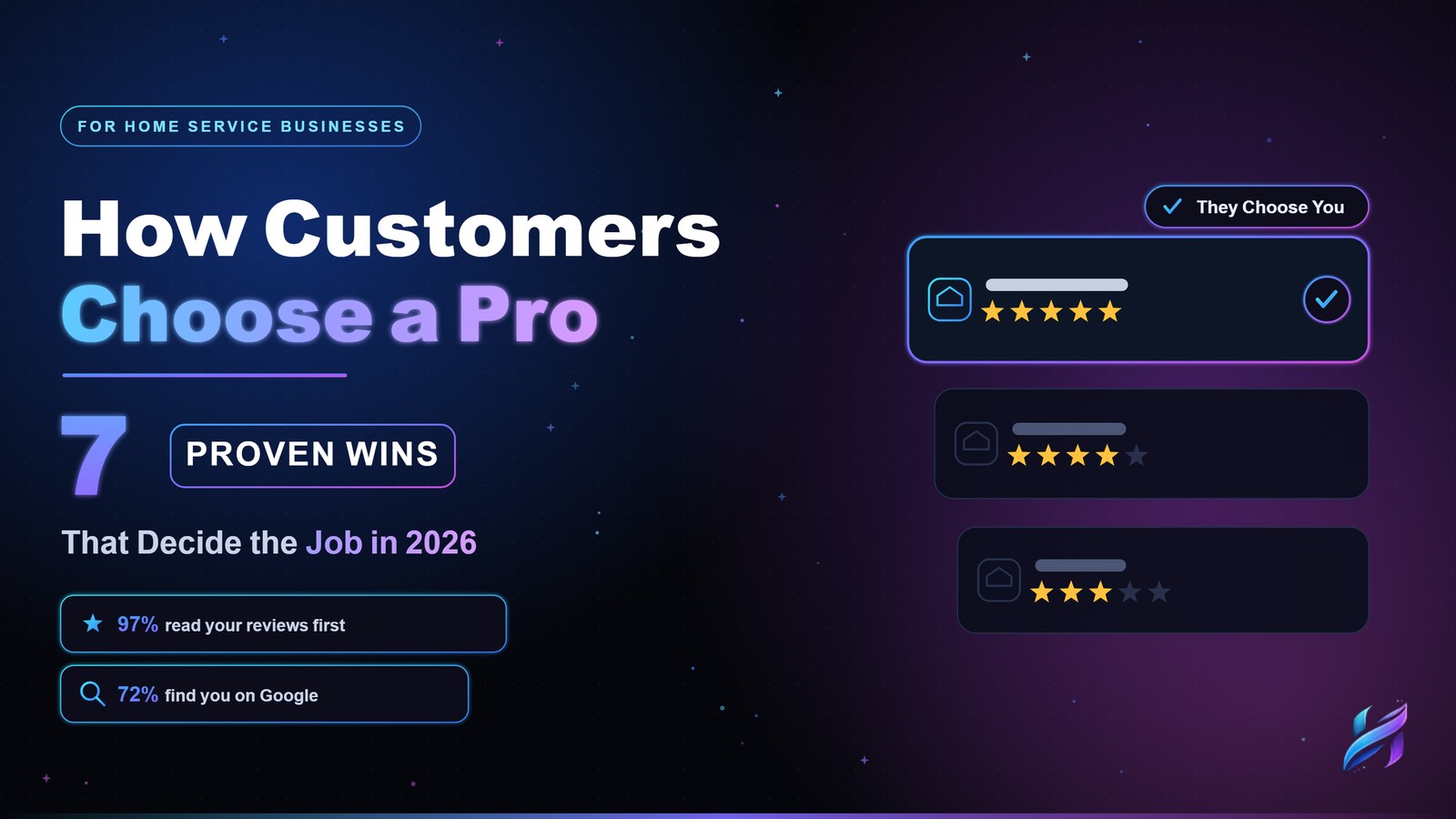
How customers choose a contractor has changed, and most owners are still pitching to a buyer who left years ago. The homeowner with a leaking roof or a dead AC unit is not flipping through a phone book. She is on her phone reading reviews, checking your star rating, and lining up two or three companies before she ever dials a number. By the time she calls, the short list is already built. The only question that matters is whether you made it.
Here is the part most local service businesses miss. You can be the best electrician in town and still lose the job to a slower, pricier competitor who simply looked more trustworthy online. The decision happens in the 10 minutes before the phone ever rings, on a screen you are not standing next to. The signals customers use in that window are knowable, and most of them are in your control.
Below are 7 proven wins that decide who gets the call in 2026, each backed by recent data on how real people pick a local pro, with the specific move that turns each one in your favor.
Table of Contents
- They Read Your Reviews Before Anything Else
- Your Star Rating Is the First Filter
- Recent Reviews Beat Old Ones
- How Customers Choose a Contractor Starts on Google
- Speed to the Callback Decides Who Wins
- Your Website Closes or Kills the Deal
- Reputation and Straight Answers Seal It
- What This Looks Like Trade by Trade
1. They Read Your Reviews Before Anything Else
Reviews are the new first impression, and almost nobody skips them. BrightLocal’s 2026 Local Consumer Review Survey found that 97% of consumers read online reviews for local businesses. Before a homeowner trusts you with a panel upgrade or a roof replacement, they are reading what your last 20 customers said about you, in their own words.
The same study found 85% of people are more likely to use a business after reading positive reviews, and 77% are deterred by negative ones. That is the whole ballgame. A handful of unanswered 1-star reviews can quietly cost you more jobs than any ad ever brought in.
The fix is unglamorous and it works. Ask every happy customer for a review while the job is fresh and the relief is real, the day you fixed the no-heat call, not three weeks later. Then reply to every review you get, good or bad. A calm, specific reply to a complaint (“we missed the window on this one and here is what we changed”) often sells the next reader better than the complaint scared them off. Buyers do not expect perfection, they expect a business that owns its work.

2. Your Star Rating Is the First Filter
Before anyone reads a single word, they scan the number. BrightLocal found 68% of consumers require at least a 4.0-star rating before they will even consider using a business, and 31% will only use a business rated 4.5 or higher. If your average sits at 3.7, you are not losing on the details. You are getting filtered out before the conversation starts.
This is good news if you do honest work, because the bar is reachable. A steady stream of real reviews from real jobs pulls a stuck average up faster than owners expect. Ten new 5-star reviews on top of an old 3.9 can move you over the line that two-thirds of buyers use to cut their list.
Make the ask part of closing out the job, not an afterthought you remember once a month. Hand the customer a simple way to leave it, a short link by text beats “look us up on Google” every time. And never buy or fake reviews. Beyond the legal risk, buyers and Google both spot the pattern, and one exposed fake undoes a hundred real ones.
3. Recent Reviews Beat Old Ones
A wall of 5-star reviews from 2022 reads as past tense. Buyers want proof you are still good now. BrightLocal found 74% of consumers look for reviews posted within the last 3 months, and 32% want reviews from the last 2 weeks. Freshness is its own ranking factor in the customer’s head, and in Google’s.
That means review collection is not a one-time push, it is a steady drip. Two or three new reviews a week keeps you looking active and busy, which is exactly the signal a homeowner wants before they hand over their address and a key to the gate.
The cleanest way to keep that drip going without nagging is automation. A text or email that goes out the moment a job is marked complete, while the customer is still happy, collects far more reviews than a person trying to remember who to ask. That is one of the jobs a good AI CRM and follow-up system handles for you, so the asks never depend on whether anyone remembered at the end of a 12-hour day.
4. How Customers Choose a Contractor Starts on Google
Reviews decide who wins, but Google decides who even gets seen. Roughly 72% of consumers use Google to find information about a local business, and 46% say they “always” or “often” add “near me” to a local search. When someone types “roofer near me” or “emergency electrician,” the three businesses in the Google map pack get the first look and most of the clicks. Everyone on page two is invisible.
Your Google Business Profile is doing more heavy lifting here than your website. Google’s own data shows searchers are 2.7 times more likely to consider a business reputable when it has a complete profile, and 70% more likely to visit it. Fill it out completely: correct hours, every service area you cover, real photos of your crew and finished work, and the exact same name, address, and phone number everywhere it appears online. Mismatched phone numbers across directories are one of the quietest reasons a profile underperforms.
The slower structural work of ranking in the regular results is where local SEO pays off, and it is why we treat the profile and the website as one connected system for every contractor we work with. Get this layer right and you stop renting every lead through ads and start owning a stream of them.

5. Speed to the Callback Decides Who Wins
Homeowners rarely contact just one company. They send three messages and go with whoever responds first and sounds like they have it handled. The foundational research on this still holds: a Harvard Business Review study of online lead response found that a business answering a web lead within 5 minutes is about 100 times more likely to connect with that lead, and 21 times more likely to qualify it, than one that waits just 30 minutes.
Five minutes, not five hours. For a crew on a roof or under a house all day, that is nearly impossible to do by hand, which is exactly why the fast competitor keeps winning jobs they are not even better at. The lead does not wait for you to climb down and check your phone at lunch.
The answer is not hiring someone to stare at a phone. It is a missed-call text-back and an instant auto-reply, so every new lead gets a real response in seconds (“thanks, we got your message and will call within the hour”) while you finish the job in front of you. That single piece of marketing automation is the highest-return switch a contractor can flip, and it directly decides who the customer chooses. Most owners are stunned at how many “lost” leads were just slow replies.
6. Your Website Closes or Kills the Deal
Once you clear the reviews and the rating, the next click is your website. BrightLocal found 54% of consumers visit a business’s website after reading positive reviews. They are not browsing, they are confirming. A slow page, no mobile layout, or a site that does not clearly say what you do and where you work hands that ready-to-buy customer back to a competitor who made it easy.
Your site does not need to be fancy. It needs to load fast on a phone, show your service area and your reviews up top, and make the phone number and a short contact form impossible to miss. If a homeowner has to pinch and zoom to find your number, you have already lost the ones who were ready to call.
This also protects every dollar you spend getting found. When you run Google Ads or Meta Ads, you are paying to send ready buyers to that page, so a site that converts is the difference between ads that pay for themselves and ads that just spend. The best lead source in the world still leaks out the bottom of a weak website.
7. Reputation and Straight Answers Seal It
The last thing a homeowner weighs is whether you feel straight with them. A 2025 Housecall Pro survey of more than 1,000 homeowners found 97% expect a contractor to be transparent before they decide to hire, and 72% would choose a company with a better customer-service reputation over a cheaper one. People are not only shopping on the number. They are shopping on whether they believe you will show up, communicate, and do what you said you would.
It compounds, too. The same research found about 3 in 4 homeowners will refer a provider after great service, and BrightLocal found 49% of consumers now trust online reviews as much as a personal recommendation. Do right by the customer in front of you and you are not just closing one job, you are feeding the review stream and the referrals that win the next ten.
Reputation is the flywheel under all six wins above. Clear communication earns the review, the review earns the ranking, the ranking earns the click, and a fast, honest callback earns the job, which earns the next review. Contractors who win consistently are not lucky. They have that loop running on purpose.
What This Looks Like Trade by Trade
The seven wins are universal, but where they bite hardest depends on the work. For HVAC companies, speed is everything in summer, the no-cooling call goes to whoever answers first, so the 5-minute callback and a clean Google profile matter more than a big ad budget. For roofing companies, the stakes per job are high and trust does the heavy lifting, so recent reviews, real storm-damage photos, and transparent process win over the lowest bid almost every time.
For electricians, safety perception drives the choice, and a complete profile with licensing details and steady 5-star reviews settles a nervous homeowner fast. For plumbers, most calls are urgent and local, so ranking in the map pack for “near me” searches and answering instantly beats almost any other lever. Different trades, same playbook, just weighted differently. Start with the win that is leaking the most jobs for your specific work.
The Bottom Line
Here is the simple version. How customers choose a contractor in 2026 is a sequence, not a single moment. They search, they scan your rating, they read your recent reviews, they check your site, and they reward whoever answers first and sounds like a pro. Miss any one link in that chain and you fall off the list before you even knew you were on it.
None of this requires being the biggest or the cheapest shop in town. It requires being the easiest one to trust in the 10 minutes a homeowner spends deciding. Fix the leak nearest the top of that list first, reviews and Google presence for most contractors, response speed for the rest, and you will feel it in your call volume within weeks, not quarters. The owners who treat their online presence as part of the job, not a chore for someday, are the ones quietly taking the work off everyone else’s table.
Want More of These Jobs Coming to You?
You do not have to fix all seven of these by hand. The reviews, the Google presence, the 5-minute callback, and a site that converts can run as one system in the background while you stay on the tools. That is exactly what we build for owner-operated contractors. See how we approach lead generation for contractors, or reach out and we will show you which of these wins is leaking the most jobs for you right now.
Frequently Asked Questions
How do most customers find a contractor in 2026?
Most customers find a contractor through Google. About 72% use Google to research local businesses and nearly half add “near me” to the search, so the map pack and your Google Business Profile are where the decision begins. Ranking there is the core of local SEO for service businesses.
How many reviews does a contractor need to get chosen?
It is less about the count and more about the rating and how recent they are. 68% of buyers require at least a 4.0-star average, and 74% look for reviews from the last 3 months, so a steady stream of fresh reviews matters more than a big pile of old ones. Automating the ask through an AI CRM keeps that stream going without you chasing it.
Does response time really affect winning the job?
Yes, more than almost anything else. Research shows responding to a new lead within 5 minutes makes you about 100 times more likely to connect than waiting 30 minutes, and homeowners usually contact several companies at once. A missed-call text-back is the simplest way to win that race, and it is a standard part of how we set up lead generation for contractors.
Why do cheaper contractors still lose the job?
Because price is not the first filter, trust is. 72% of homeowners say they would pick a company with a better service reputation over a cheaper one, and 77% are turned away by negative reviews no matter the price. A low bid with a 3.6-star rating loses to a fair bid with a fresh 4.8 nearly every time.
What is the fastest way to get chosen by more local customers?
Stack the signals customers actually use: keep your star rating above 4.0 with recent reviews, complete your Google Business Profile, and respond to every lead within minutes. Do those three and you cover most of how customers choose a contractor today. Pairing them with AI search optimization makes sure you also show up when buyers ask an AI assistant for a recommendation.