
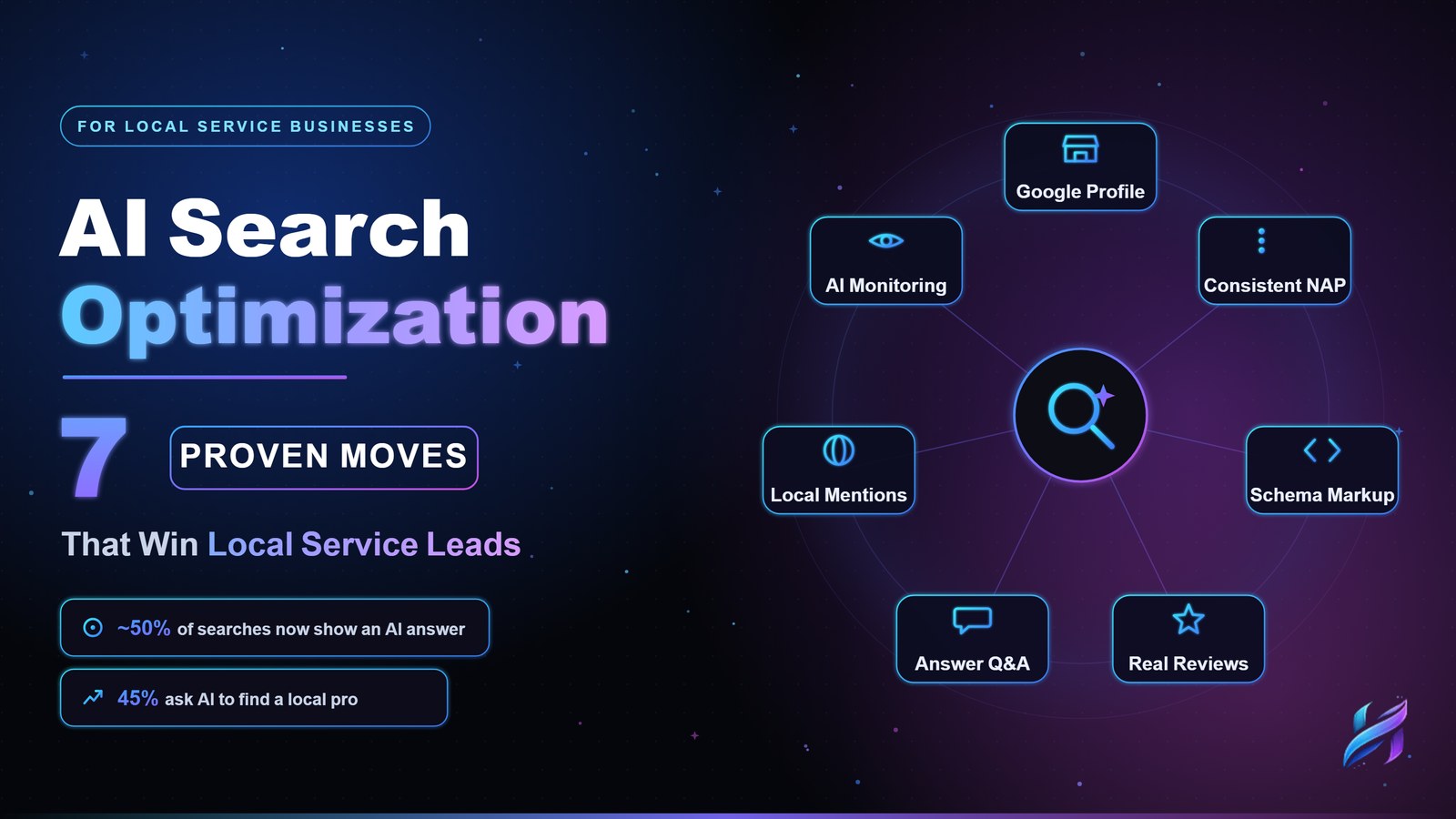
AI search optimization is the work of making your business the one ChatGPT, Perplexity, and Google’s AI Overviews name when someone asks who to call. It is not classic SEO with a new coat of paint.
When a homeowner types “best HVAC company near me” into an AI tool, that tool does not hand back ten blue links. It picks a short list and explains why. If your business is not on that list, the lead never sees you. This guide is 7 proven moves to get named, built on what the 2026 data actually shows, not what the hype says.
Key Takeaways
- Roughly half of Google searches now show an AI Overview, and a top organic result loses about 58% of its clicks when one appears.
- 45% of consumers used an AI tool to find a local business in the past year, up from 6% the year before. Your buyers are already asking.
- Schema markup helps AI read your site, but a 2026 study found no link between schema coverage and getting cited. It is infrastructure, not a shortcut.
- What moves the needle in AI search optimization for local service businesses: a complete Google Business Profile, identical contact details everywhere, real reviews, and plain answers to the questions buyers type.
Table of Contents
- What AI Search Optimization Means for Local Service Businesses
- Why This Matters Now: The 2026 Data
- Move 1: Make Your Google Business Profile Airtight
- Move 2: Get Your Name, Address, and Phone Identical Everywhere
- Move 3: Use Schema as Infrastructure, Not a Magic Bullet
- Move 4: Stack Reviews That AI Can Actually Read
- Move 5: Answer the Exact Questions Buyers Ask
- Move 6: Earn Mentions on Sites AI Already Trusts
- Move 7: Monitor What AI Says About Your Business
- Frequently Asked Questions
What AI Search Optimization Means for Local Service Businesses
AI search optimization is the practice of shaping every signal an AI assistant reads about your business so it recommends you by name. Classic SEO fought for a rank on a page of links. AI search skips the page. It reads the open web, your business listings, your reviews, and a handful of trusted sources, then writes one answer. For a service business, that answer is a recommendation: a name, a phone number, a reason. You are either in it or you are invisible.
Here is the part most owners miss. AI does not pick the prettiest website. It picks the business it can describe with confidence. That means consistent facts across the web, plain-language answers to common questions, and proof from third parties that you are real and good at the work. A roofer with 200 honest reviews and identical contact details on every directory beats a roofer with a slicker site and a messy footprint. That is the whole game, and it is winnable without a big budget.
The good news for owner-operated shops: the businesses that win AI search are rarely the biggest. They are the most consistent. A focused HVAC, electrical, or plumbing company can out-rank a national chain in its own city because it controls its own facts. That is why we treat SEO for local service businesses as the foundation under every ad dollar, not a separate project.

Why This Matters Now: The 2026 Data
AI search is not a someday problem. It is changing how leads find you today. By February 2026, Google AI Overviews appeared on about 48% of tracked searches, up from roughly 30% a year earlier, according to BrightEdge research. Roughly half of the searches your customers run now start with an AI answer, not a list.
That answer eats clicks. Ahrefs measured a 58% drop in average click-through rate for the top organic result when an AI Overview shows up. Seer Interactive, reported by Search Engine Land, found organic click-through on those queries fell from 1.76% to 0.61%. The same study found one bright spot: brands cited inside the AI Overview earned 35% more organic clicks than those left out. Getting named is the new front page.
And buyers are leaning in. A 2026 BrightLocal consumer survey found 45% of people used an AI tool to find a local business in the past year, up from 6% the year before. ChatGPT led at 31% of those users, Google’s AI Mode at 23%. AI is now the third most common way people find local businesses, behind only Google search and Facebook. If you sell to homeowners, they are already asking a machine who to trust.
One more number that reframes the work: BrightEdge found only about 17% of the sources cited in AI Overviews also rank in the organic top ten. AI picks its recommendations on different logic than the old rankings. That is the opening, and the seven moves below are the core of AI search optimization for local service businesses.
Move 1: Make Your Google Business Profile Airtight
Your Google Business Profile is the single biggest input AI assistants read about a local business. Whitespark’s local ranking research puts the profile at roughly 32% of what decides the local map results, the largest single factor. AI tools pull from the same well, so this profile is where AI search optimization pays off first. A half-finished profile tells the machine you might not be open, or real.
Fill every field. Exact business name, primary and secondary categories, hours, service area, services with descriptions, and at least a dozen current photos. Owners who skip the services list lose the most, because that list is where you tell Google and every AI reading it exactly what you do. A plumber who lists “water heater repair, drain cleaning, repiping, slab leak detection” gives AI the vocabulary to recommend them for each one. A plumber who lists nothing gives AI nothing to say.
Keep it active. Post updates, answer questions in the Q&A, and respond to every review. SOCi research found business details were only about 68% accurate on ChatGPT and Perplexity, and AI assistants quietly drop locations with incomplete or inconsistent data. An abandoned profile is a profile AI stops trusting.
Move 2: Get Your Name, Address, and Phone Identical Everywhere
AI builds confidence from agreement. When your name, address, and phone number (your NAP) match across Google, Yelp, Facebook, Angi, the BBB, and your own site, the machine reads one clear business. When they conflict, it reads doubt, and doubt does not get recommended.
This is where most service businesses leak. An old suite number on one directory. A tracking phone number on another. “Mike’s HVAC LLC” in one place and “Mikes Heating & Air” in another. Each mismatch is a small reason for AI to hedge or pick the competitor whose details line up. Audit every listing, pick one exact format for your name, address, and phone, and make all of them match it to the character.
Consistency is unglamorous and it wins. It is the cheapest move in AI search optimization and the one most owners never finish. Do it once, then check it twice a year.

Move 3: Use Schema as Infrastructure, Not a Magic Bullet
Schema markup is code that labels your pages so machines read them cleanly: this is the business name, this is the phone, these are the services, this is a review. LocalBusiness and Service schema help AI parse your site without guessing. You want it in place. Here is the honest part the schema vendors leave out: it is not a citation cheat code.
A 2026 analysis covered by Search Engine Land found no correlation between how much schema a site had and how often AI search cited it. Schema is infrastructure. It helps the machine read you accurately, which matters, but it does not make the machine prefer you. Adding more schema to a thin, inconsistent site does nothing.
So the right amount of schema is: enough to label your core facts correctly, then stop. Get LocalBusiness markup with consistent NAP, mark up your services and your reviews, and move your energy to the moves that actually earn citations. Treating schema as the whole strategy is the most common way owners waste a budget on AI search optimization.
Move 4: Stack Reviews That AI Can Actually Read
Reviews are proof, and AI leans on proof. Whitespark’s research weights review signals at around 16% of local ranking, and AI assistants quote ratings and review themes directly when they recommend a business. In AI search optimization, reviews are some of the strongest proof you control. Volume, recency, and what the reviews actually say all feed the answer.
Two things matter beyond the star count. First, recency: a steady stream of fresh reviews tells AI you are active and current, while a wall of five-year-old reviews reads as a business that may be gone. Aim for a few new reviews every month, not a one-time push. Second, language: when customers mention specific services and outcomes, AI has real phrases to pull. A review that says “replaced our AC in one afternoon” helps AI recommend you for AC replacement far more than “great service.”
Ask every happy customer, make it one tap, and respond to all of them, including the bad ones. A calm, specific response to a one-star review is read by both the next human and the next machine. This is exactly the kind of follow-up we automate inside AI CRM and marketing automation so the asks go out on their own.
Move 5: Answer the Exact Questions Buyers Ask
AI assistants are answer machines. They reward content that answers a real question in plain language, fast, near the top. For a service business, that means pages and posts that take the actual questions your customers ask and answer them directly: “How much does it cost to replace an electrical panel?” “How long does a roof replacement take?” “Do you offer emergency service at night?”
Lead each answer with the answer. Do not bury it under three paragraphs of background. AI pulls the first clear sentence that resolves the question, so put it first, then add the detail. Write the way your customer would say it out loud, because half of these queries are spoken. This answer-first habit is the content half of AI search optimization, and the reward is being the source the AI quotes, with your name attached.
This is also where you separate from competitors who only have a homepage and a contact form. A library of straight answers, one per common question, gives AI dozens of reasons to mention you. We map this out the same way we plan paid campaigns for local businesses: start from what the buyer is actually trying to do.

Move 6: Earn Mentions on Sites AI Already Trusts
AI does not just read your site. It reads the web’s view of you. When your business shows up on sources the model already trusts, local news, established directories, trade associations, supplier “find a pro” pages, a chamber of commerce, each mention is a vote that you are real and worth naming. Off-site mentions are the trust half of AI search optimization.
You do not need a national PR push. You need a handful of credible local and industry mentions that line up with everything else you have published. Get listed in the directories that serve your trade, ask suppliers to add you to their dealer or installer pages, and pitch one useful local story a quarter. These are the off-site signals AI weighs when it decides whose name to put in the answer.
Consistency carries here too. Every new mention should use the same name, address, and phone as everywhere else. A scattered footprint of mismatched mentions can do more harm than no mentions at all.
Move 7: Monitor What AI Says About Your Business
You cannot fix what you never check. Once a month, ask the AI tools your customers use what you would ask if you needed your own service. “Who is the best electrician in [your city]?” “Recommend a reliable roofer near [your area].” See whether you show up, what the AI says about you, and whether anything is wrong.
BrightLocal found that while 63% of AI users trust the recommendations they get, 88% still go verify them. So the AI answer is the first impression and the click-through is the second. If the AI lists an old phone number or a service you dropped, that is a lead walking into a wall. Catching it is a five-minute check, and fixing it usually traces back to one of the moves above: a stale listing, a NAP mismatch, an outdated profile.
Treat AI search optimization the way you treat your equipment: inspect it on a schedule. The businesses that win are not the ones who set it and forget it. They are the ones who check the answer, find the gap, and close it before the competitor does.
Where to Start With AI Search Optimization
Seven moves can read like a lot of work, so here is the order that gets results fastest. Start with the consistency moves, because they are free and they move first. Fix your Google Business Profile, then make your name, address, and phone identical on every listing you can find. Those two alone clean up most of the doubt that keeps AI from naming a local business.
Next, build the proof. Set a simple system that asks every happy customer for a review, and write one straight-answer page for each question buyers ask most. Those compound. Save the schema and the off-site mentions for once the foundation is solid, since AI search optimization rewards a consistent, well-reviewed business far more than a marked-up one. None of this requires a national budget. It requires control of your own facts and the patience to keep them current.
If you would rather not run AI search optimization in-house, that is the work HelixEdge does for owner-operated service businesses every day: lock the listings, build the reviews, write the answers, and watch what the machines say back.
Frequently Asked Questions
What is AI search optimization for a local business?
AI search optimization is the work of making your business the one AI tools like ChatGPT, Perplexity, and Google AI Overviews recommend by name when someone asks for a service. It comes down to consistent business facts, strong reviews, and plain answers to common questions. It pairs with your local service marketing rather than replacing it.
Is AI search optimization different from SEO?
Yes. Traditional SEO competes for a rank on a page of links. AI search optimization competes to be named inside a single AI answer, which is decided more by consistency, reviews, and third-party trust than by classic ranking factors. The two overlap, so a strong SEO foundation still helps.
Does schema markup get my business cited by AI?
Not on its own. Schema helps AI read your site accurately, but a 2026 study found no correlation between schema coverage and AI citations. Add LocalBusiness and Service schema as a clean foundation, then spend your effort on reviews and real answers. We handle this inside our marketing automation setup.
How long does AI search optimization take to work?
Listing and profile fixes can show up in AI answers within weeks, because the tools re-read those sources often. Reviews and off-site mentions compound over months. The fastest wins in AI search optimization are the consistency fixes, which is why we start there for electricians and other trades.
Get Found When Your Customers Ask AI Who to Call
Your next customer is asking an AI tool for a recommendation right now. That is the whole point of AI search optimization: HelixEdge gets local service businesses named in that answer, then turns the click into a booked job. If you want your business to be the one the machine recommends, let’s talk.