
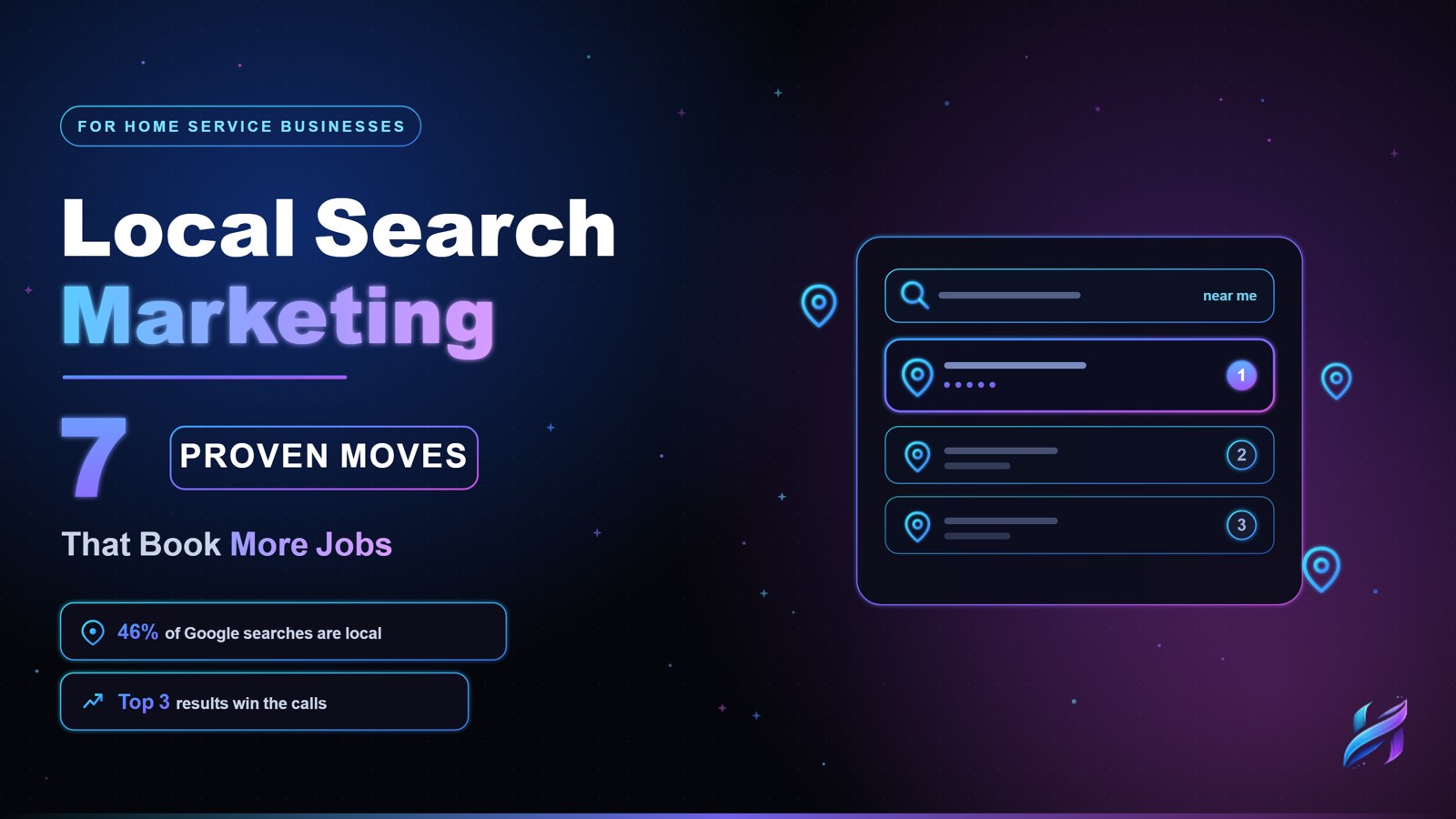
When someone needs an electrician, a plumber, or an AC repair, they pull out their phone and search. The businesses that show up in the top three map results get the call. Everyone below the fold gets ignored. Local search marketing is how you become one of those top three, and for a home service business it is the cheapest, highest-intent lead source you have. These are people searching for exactly what you do, in the area you serve, ready to book.
This is the playbook we run for owner-operated service companies. No fluff, no vanity metrics, just the seven moves that put you in front of customers at the moment they are ready to call. Done right, local search marketing turns your Google presence into a steady stream of booked jobs instead of a digital business card nobody finds.
Table of Contents
- Why Local Search Marketing Wins for Home Service Businesses
- Move 1: Own Your Google Business Profile
- Move 2: Lock Down Consistent NAP and Citations
- Move 3: Turn Reviews Into a System
- Move 4: Build Service and Area Pages That Rank
- Move 5: Earn the Map Pack With Real Signals
- Move 6: Get Local Links and Mentions
- Move 7: Track Calls So You Know What Works
Why Local Search Marketing Wins for Home Service Businesses
Almost half of all Google searches have local intent, and for home services that number is even higher. Nobody searches for an emergency plumber three states away. They search for one nearby, they look at the map pack, and they call one of the first names they see. That is the entire game, and local search marketing is how you win it.
The intent is what makes it so valuable. A homeowner typing “AC repair near me” at 2 p.m. in July is not browsing, they are buying. Compare that to an awareness ad that interrupts someone scrolling. Local search puts you in front of demand that already exists, which is why the cost per booked job is almost always lower than any other channel. The goal is revenue, not impressions, and search delivers revenue.
Most of your competitors treat their online presence as a formality. Their Google profile is half filled out, their reviews are stale, and their website never mentions the towns they actually serve. That is good news for you. Local search marketing is one of the few areas where steady, unglamorous work beats a bigger ad budget, because the businesses that do the basics well are still rare.
There is also a defensive reason to take this seriously. The map pack only has three spots. If you are not in them, a competitor is, and they are taking calls that should be yours every single day. Every week you leave your local presence half-built is revenue walking out the door to whoever did the work. Local search marketing is not optional in a trade where customers decide in the first three results.

Move 1: Own Your Google Business Profile
Your Google Business Profile is the single most important asset in local search marketing. It is what powers the map pack, the panel on the right of search results, and your presence in Google Maps. If you do one thing this week, claim it, verify it, and fill out every field.
Pick the most accurate primary category, then add every relevant secondary category. List your real services with descriptions. Set your service area to the towns you actually cover. Add real photos of your trucks, your team, and finished work, because profiles with photos get more calls and direction requests. Keep your hours current, including holidays, so you never turn a ready customer away with a wrong listing.
Then use it. Post updates, answer the questions people leave, and add new photos every month. Google rewards active profiles, and an active profile signals to a customer that you are a real, responsive business. The official Google Business Profile guidelines spell out what is allowed, and staying inside them protects you from suspensions that can wipe out your visibility overnight.
One more thing owners overlook: the messaging and call buttons. Turn them on and treat them like the front desk. A customer who taps call or message from your profile expects an answer now, and the businesses that respond fastest book the job. Your profile is not a billboard, it is a lead channel, and every part of local search marketing should funnel that ready customer to a fast, human response.
Move 2: Lock Down Consistent NAP and Citations
NAP stands for name, address, and phone number. It sounds trivial, and it is the most common thing local businesses get wrong. If your phone number is formatted three different ways across your website, your Google profile, Yelp, and an old directory, you are sending mixed signals to the search engines that decide who ranks.
Pick one exact version of your business name, address, and phone, down to the suite number and the way you write “Street” versus “St.” Then make every listing match it. Start with the big ones: Google, Bing Places, Apple Maps, Yelp, Facebook, and the major industry directories. Consistency builds the trust that local search marketing runs on, because the engines cross-check your details across the web before they decide where to rank you.
This is one-time cleanup with a long tail of benefit. Fix the inconsistencies once, keep a simple record of your canonical NAP, and update every listing the day anything changes. Old, wrong listings do not just fail to help, they actively pull rankings down and send customers to a dead phone line.
Watch for the duplicate listings that quietly pile up over the years, an old address from a move, a second profile a former employee created, a directory that auto-generated a page for you. Each duplicate splits your signals and confuses customers. Claim or remove them so there is exactly one clean version of your business everywhere it appears. Tidy citations are unglamorous, but they are the foundation the rest of local search marketing is built on.
Move 3: Turn Reviews Into a System
Reviews are the currency of local search marketing. They influence your map rankings, and they are often the deciding factor when a customer is choosing between you and the shop next to you. According to the BrightLocal local consumer review survey, the overwhelming majority of consumers read reviews before they hire a local business, and they care about both the rating and how recent it is.
The businesses that win do not leave reviews to chance, they build a system. Ask every satisfied customer, every time, the day the job is done while the experience is fresh. Make it one tap with a direct review link sent by text. A simple, consistent ask turns a handful of random reviews a year into a steady, growing stream.
Then answer them, all of them. Thank the happy ones by name and respond to the critical ones calmly with a path to fix it. Public, professional responses show future customers how you treat people, and they show Google an engaged business. A steady flow of recent, well-handled reviews is one of the strongest ranking signals you can build, and it compounds over time.

Move 4: Build Service and Area Pages That Rank
Most home service websites have one thin services page and call it done. That is a missed opportunity. Each core service deserves its own page that answers what the service is, what it costs to think about, what the process looks like, and why you are the right call. Depth ranks, and a dedicated page can rank for dozens of specific searches a generic page never will.
The same goes for the areas you serve. A genuine page for each town or region, with real local detail rather than a copy-paste with the city name swapped, helps you show up when someone searches your service plus their location. Done honestly, this is one of the highest-leverage parts of local search marketing. Done as spammy duplicate pages, it backfires, so write each one like it matters.
Tie it together with clear internal links so every service and area page connects to the others and to your contact page. If you want this built and managed for you, that is exactly what our SEO services handle, and we tailor the page structure to the specific trades and areas you work in, whether that is HVAC, electrical, plumbing, or roofing.
Write these pages for the customer first and the search engine second. Answer the questions you hear on every sales call: how fast can you come out, do you offer financing, are you licensed and insured, what does the visit involve. A page that genuinely helps a worried homeowner decide is the same page Google wants to rank, because it does the job a searcher came to do. Helpful and rankable are the same thing when you write honestly.
Move 5: Earn the Map Pack With Real Signals
The map pack, those top three local results with the map, is where the calls come from. Google decides who lands there using three things: relevance, distance, and prominence. You cannot move your business closer to every searcher, but you have real control over relevance and prominence, and that is where local search marketing earns its keep.
Relevance comes from a complete, accurate profile and a website that clearly states what you do and where. Prominence comes from your reviews, your citations, your links, and your overall reputation across the web. Every move in this playbook feeds the map pack, which is why they work together rather than in isolation. There is no single trick, just a stack of signals that adds up to Google trusting you with the searcher.
Proximity is the one factor you cannot fully control, which is why your service area pages and category settings matter so much, they help Google understand the full territory you cover. The stronger your relevance and prominence, the wider the radius where you can still win the pack even when you are not the closest option.
This is also why local search marketing rewards patience over hacks. Businesses chasing a single ranking trick get leapfrogged the moment Google adjusts. Businesses that quietly stack a complete profile, real reviews, solid pages, and genuine links build a position that is hard to knock out, because no one signal is holding it up. You are building a moat, not buying a billboard.
Move 6: Get Local Links and Mentions
Links from other local websites tell Google you are an established part of the community, and they are one of the harder signals for competitors to copy. You do not need hundreds, you need a handful of genuine, local, relevant ones built steadily over time.
Sponsor a youth sports team and get listed on their site. Join the local chamber of commerce. Partner with complementary trades and link to each other. Get quoted in a local news piece or a community blog. Each of these is a real-world relationship that produces a link and often a referral, which is the kind of double win local search marketing should aim for.
Avoid the shortcuts. Bought links and spammy directory blasts can get you penalized and erase months of progress. A few strong local mentions a year, earned through real connections, beats a pile of junk every time and keeps your foundation safe.
The bonus is that local links rarely come alone. The chamber membership, the team sponsorship, the partnership with the plumber two towns over, those relationships send referral work directly, on top of the ranking signal. That is the kind of compounding return local search marketing is built for: one move that feeds both your visibility and your pipeline at the same time.
Move 7: Track Calls So You Know What Works
You cannot improve what you do not measure, and most home service businesses have no idea which calls came from their Google presence. Local search marketing without tracking is just guessing. Set up call tracking and watch which sources actually produce booked jobs, not just clicks.
Tie it back to revenue. A channel that drives ten cheap clicks but no jobs is worth less than one that drives two calls that both book. When you can see cost per booked job by source, you stop spending on what looks busy and start investing in what makes money. That is the whole point: marketing is an investment, not an expense, and tracking is what proves the return.
Pair your tracking with a fast follow-up process, because speed-to-lead decides who wins the job. A missed call is a job handed to your competitor. If you want the search visibility and the system that turns those calls into booked work, see how we approach lead generation for contractors, and how local search now overlaps with AI search optimization as more people ask an assistant to find them a local pro.
Frequently Asked Questions
How long does local search marketing take to work?
Some moves pay off fast. A fully optimized Google Business Profile and a steady review system can lift your map visibility within weeks. Service and area pages and local links build over a few months. Local search marketing is a compounding asset, not a switch, but unlike paid ads the results keep working after the initial effort. Our SEO services page explains the timeline we set with clients.
Do I need a website, or is a Google Business Profile enough?
The profile is essential, but a website makes it far stronger. Your service and area pages give Google the relevance signals that lift your map rankings, and they give customers a reason to choose you over a bare listing. The two work together, which is why local search marketing always includes both.
Is local search marketing better than running ads?
They do different jobs. Local search marketing builds an asset that keeps producing leads at a low cost per job over time, while paid ads buy visibility instantly. Most service businesses do best with both, and the right mix depends on your market and goals. We help owners decide where each dollar works hardest.
Which home service trades does this work for?
All of them. HVAC, electrical, plumbing, roofing, pressure washing, and more all live and die by local search, because their customers all search nearby and call from the map pack. The moves are the same, the specifics differ by trade, and we tailor the plan to yours.
Ready to Win Local Search in Your Market?
We build and run local search marketing for owner-operated home service businesses, the kind that wants more booked jobs, not more vanity metrics. If you are tired of watching competitors take the calls that should be yours, let us audit your Google presence and show you exactly where the jobs are leaking. Stop wasting budget on awareness and start driving real revenue. Reach out to HelixEdge and we will map the plan to your trade and your area.