Google Ads for HVAC works because nobody shops for air conditioning repair early. The AC dies at 9 pm in July, somebody types repair near me into their phone, and the company at the top of that search gets the call. Google Ads is how you buy that spot on purpose instead of hoping for it.
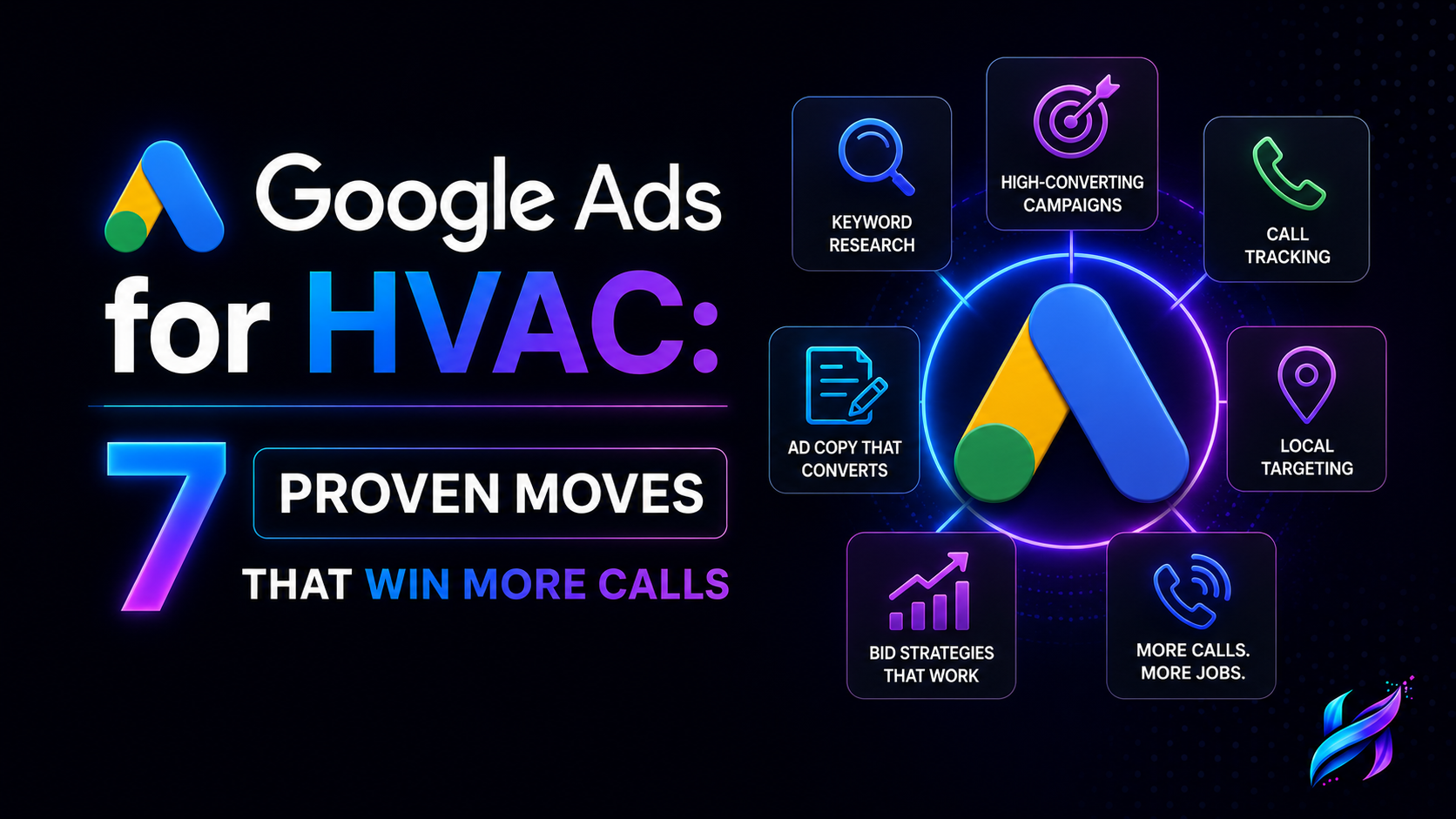
This guide covers the 7 moves that separate HVAC campaigns that print booked jobs from campaigns that eat budget: campaign structure, emergency bidding, negative keywords, seasonal budgets, call tracking, and how Local Services Ads fit in.
Table of Contents
- Why Google Ads for HVAC Works When the AC Dies
- The 7 Proven Moves
- How to Set Up the Campaign, Step by Step
- Ad Copy That Wins the Emergency Click
- What Google Ads Costs an HVAC Company
- Quality Score: Why Your Clicks Cost More Than the Other Guy’s
- Track Calls or You Are Guessing
- A 90 Day Google Ads Plan for an HVAC Shop
- Google Ads or Facebook First for HVAC?
- The Bottom Line
- 5 Google Ads Mistakes HVAC Companies Keep Making
- Frequently Asked Questions
Why Google Ads for HVAC Works When the AC Dies
HVAC demand is the most urgent in all of home services. A roof leak can wait until the weekend. A house at 88 degrees with kids in it cannot. When the system quits, homeowners do not scroll social media or ask for referrals. They search, they call the first two or three companies they see, and they hire whoever answers and shows up first.

That urgency is why search beats every other channel for HVAC service revenue. The intent is already there; the only question is whose name is at the top when it happens. Organic rankings take months to earn. Google Ads buys the position today, and you only pay when somebody clicks.
The 7 Proven Moves
Almost every losing HVAC campaign we audit breaks one of these. Almost every winning one runs all seven.
1. Split repair and replacement into separate campaigns
A repair search and a replacement search are different customers with different tickets. One wants a tech today for a few hundred dollars; the other is comparing $8,000 to $15,000 systems over weeks. Give each its own campaign, its own budget, its own ads, and its own landing page, so the $15,000 intent never starves behind $300 clicks.
2. Bid on emergency terms and own the night
Emergency repair, 24 hour AC repair, AC not cooling: these searches happen at night and on weekends, exactly when most of your competitors’ offices are closed. Use ad scheduling to raise bids in the evening and keep ads running through the weekend. If you offer after-hours service, say it in the headline, because almost nobody else does.
3. Build the negative keyword wall
Free, DIY, how to, salary, jobs, school, certification, parts, manual, rental. Every one of those words attached to an HVAC search is a click you pay for and a customer you will never get. Load the negative list on day one and add to it weekly from the search terms report. This is the single fastest way to stop the quiet bleed in an HVAC account.
4. Match the budget to the season
HVAC demand is a sine wave and most budgets are a flat line. Raise daily budgets ahead of the first heat wave and the first freeze, then pull back in the shoulder months and run tune-up and maintenance offers instead of letting the budget idle. The shop that funds May properly owns June.
5. Use call-only ads and call extensions
An overheated homeowner on a phone does not want to fill out a form. Call-only ads put a tappable phone number where the headline would be, and call extensions add one to every other ad. For emergency campaigns, calls are the conversion, so make the phone the whole point.
6. Send clicks to a page that matches the ad
A replacement ad should land on a replacement page with financing options, not the homepage. A repair ad should land on a page with a giant phone number and tonight’s availability. Every mismatch between the ad and the page is paid traffic deciding you are not what they searched for.
7. Run Local Services Ads alongside search
Google Local Services Ads sit above regular search ads, carry the Google Guaranteed badge, and charge per lead instead of per click. They are not a replacement for search campaigns, because LSA inventory is limited and rankings there are driven by reviews and response speed. Run both: LSA for the badge and the cheap leads it does produce, search ads for the coverage LSA cannot give you.
How to Set Up the Campaign, Step by Step
The first campaign of Google Ads for HVAC takes an afternoon, and the order matters: tracking gets built before a single dollar moves, because a campaign that cannot see calls cannot be judged.
- Create the Google Ads account and skip Smart mode. Switch to Expert mode immediately. Smart campaigns hide the controls that make everything else in this guide possible.
- Set up conversion tracking first. Import calls from ads, calls from the website, and form fills as separate conversion actions. If the account cannot count calls, stop and fix that before launch.
- Build the repair campaign. Search campaign, your service area only, with 15 to 25 tightly themed repair keywords in phrase and exact match. Leave broad match off until the negative list has matured.
- Build the replacement campaign. Same structure, replacement and installation keywords, its own budget, and ads that talk financing instead of speed.
- Load the negative keyword wall. The list from move 3 goes in before launch, not after the first wasted week.
- Add the extensions. Call extension on everything, sitelinks for financing, maintenance plans, and emergency service, location extension tied to your Business Profile.
- Launch and let it learn. Two weeks of data before structural changes. Check search terms twice a week, add negatives, and touch nothing else.
None of these steps is hard. The discipline is doing them in this order, because the shops that launch first and track later are the ones that quit Google Ads calling it a slot machine.
Ad Copy That Wins the Emergency Click
Emergency searchers compare three headlines for about two seconds, and they pick on speed, availability, and risk. Your copy has one job: answer tonight, here, guaranteed faster than the two ads next to you.
- Lead with availability: Same Day AC Repair, Open Tonight, Techs Available Now. Speed is the product.
- Name the area: a headline with the searcher’s county or metro outperforms a generic one, because it answers the only other question that matters: can you get here.
- Kill the risk: upfront pricing, no overtime charges, licensed and insured, satisfaction guaranteed. Pick the two you can actually promise.
- Skip the slogans: nobody melting at 9 pm cares that you have been family owned since 1987. Put credentials in description line two, not the headline.
Replacement copy plays a different game. Those searchers are comparing for weeks, so the winning ads talk financing from monthly payment amounts, free in-home estimates, and trade-in or rebate offers, then retarget patiently instead of shouting tonight.
What Google Ads Costs an HVAC Company
HVAC clicks are among the most expensive in local services because every shop in town wants the same emergency searches. Depending on the market, repair clicks commonly run $15 to $40, and replacement terms can go higher. Your market sets the real number; Google’s Keyword Planner shows it for free before you spend a dollar.
The arithmetic matters more than the click price. At $25 a click, a $2,500 monthly budget buys about 100 visits. If one in ten calls and half of those book, that budget produced 5 jobs, and one replacement among them pays for the quarter. Expensive clicks are fine; expensive booked jobs are the thing to watch.
Most owner operated shops should start between $1,500 and $3,000 a month in spend, concentrated on one or two campaigns rather than spread thin. The fastest way to waste that money is managing it by gut feel, which is exactly what our Google Ads management exists to prevent.
Quality Score: Why Your Clicks Cost More Than the Other Guy’s
Google discounts ads it considers relevant and taxes ads it does not, through Quality Score. Two HVAC shops bidding on the same keyword routinely pay different prices for the same position because one matched keyword, ad, and landing page and the other sent everything to the homepage.
The practical version: tight keyword themes per ad group, the keyword in the headline, and a landing page about exactly that service. Do that and the engine quietly subsidizes you against every sloppy account in your market, which in HVAC is most of them.
Track Calls or You Are Guessing
Most HVAC conversions are phone calls, and a campaign that cannot see calls looks like a failure even when it is printing jobs. Before scaling anything: call tracking numbers on the ads and landing pages, calls recorded and tied back to the keyword that produced them, and every lead pushed into a CRM that knows whether the job booked.

Speed matters as much as tracking. An emergency caller who hits voicemail calls the next ad down, and your click already got billed. Answer every ad call live during business hours and use an automatic text-back after hours, which is the first thing we wire up in our AI CRM and automation setups.
A 90 Day Google Ads Plan for an HVAC Shop
Here is the schedule we run when Google Ads for HVAC starts from zero. Ninety days produces a number you can build a business plan on.
Days 1 to 30: validate
Repair campaign live first, replacement a week later. Budget at the bottom of your range, negatives added twice a week, every call answered live. The only deliverable is a clean cost per booked job for each campaign.
Days 31 to 60: cut and concentrate
Kill the keywords that spend without booking, move their budget to the ones that book, and raise bids on after-hours windows where you win. Apply for Local Services Ads now so the badge is earning by month three.
Days 61 to 90: scale into the season
Raise budgets ahead of the next weather swing, not after it. Add the maintenance plan campaign in shoulder season, turn on remarketing for replacement quotes that have not closed, and lock the weekly routine: search terms, negatives, budget pacing, 20 minutes.
Google Ads or Facebook First for HVAC?
For HVAC service revenue, Google first, and it is not close. Emergencies are search-driven, and search is where the highest intent lives. Facebook earns its budget later, for replacement campaigns, maintenance plans, and staying remembered between breakdowns.
A simple split once both are running: roughly three quarters of budget to search while the schedule has holes, shifting toward brand and replacement campaigns as the calendar fills. The full comparison is in our Google Ads vs Meta Ads breakdown.
The Bottom Line
Split repair from replacement. Own the after-hours searches. Wall off the junk clicks with negatives. Fund the season before it peaks, make the phone the conversion, match every landing page to its ad, and let Local Services Ads stack on top. Then judge the whole thing on one number, cost per booked job, after 30 days.
Run those seven moves and Google Ads for HVAC stops being a slot machine and starts being a dial: more budget in, more booked calls out, at a cost you can predict. Start with the repair campaign this week, add replacement the week after, and let the first 30 days of data make every decision from there.
5 Google Ads Mistakes HVAC Companies Keep Making
Most losing HVAC accounts are not unlucky, they are leaking in one of five places. Check these before blaming the platform.
1. Auto-applied recommendations left on
Google will happily rewrite your keywords, raise your budgets, and loosen your match types automatically. Turn auto-apply off and treat every recommendation as a suggestion from a salesman, because that is what it is.
2. The Display Network switched on by accident
New search campaigns ship with Display expansion pre-checked. For an emergency service, banner impressions on recipe sites are pure waste. Uncheck it at creation and confirm in settings.
3. Broad match with an empty negative list
Broad match without negatives buys you searches about HVAC salaries, certification courses, and DIY repairs. Phrase and exact match first, broad only after the negative wall has a few months of bricks in it.
4. Counting clicks instead of booked jobs
A campaign with cheap clicks and no booked jobs is a bad campaign with good cosmetics. Cost per booked job is the only metric that pays the techs.
5. Rebuilding the account every time Google calls
The free account reviews from Google reps optimize for spend, not profit. Listen politely, take notes, and change nothing until the data agrees with the advice.
Frequently Asked Questions
How much should an HVAC company spend on Google Ads?
Between $1,500 and $3,000 a month is a realistic starting range for an owner operated shop, concentrated on one or two campaigns. Judge it on cost per booked job at day 30, not click prices. Our Google Ads management page breaks down what professional management changes.
Are Local Services Ads better than regular Google Ads for HVAC?
Neither replaces the other. LSA charges per lead and carries the Google Guaranteed badge but has limited inventory, and rankings depend on reviews and response speed. Search ads cost more per click and give you control and coverage. The shops that win run both.
Why are my HVAC Google Ads not getting calls?
Usually one of three things: broad match keywords with no negative list, ads landing on the homepage instead of a matching page, or calls going to voicemail. If you cannot say which one it is, book a free audit and we will find it.
How long does it take for Google Ads to work for HVAC?
Impressions and clicks start the first day, and a trustworthy cost per booked job takes about 30 days of data. More of the patience math lives on our marketing tips blog.
What keywords should HVAC Google Ads target?
Start with the money searches: AC repair, emergency HVAC repair, AC not cooling, furnace repair, HVAC replacement, and new AC unit cost. Split them by repair and replacement intent, add your service area names, and let the search terms report teach you the rest weekly.
Do Google Ads work for small HVAC companies?
Yes, and focus is the equalizer. One campaign, one service, one tight service area beats a big competitor’s unfocused account every day. That focused build is exactly what we run for shops in our HVAC marketing engagements.
Ready to Turn Searches Into Service Calls?
HelixEdge builds and manages Google Ads for HVAC companies that want booked jobs, not click reports. Book a free audit and we will show you where your budget is leaking.