
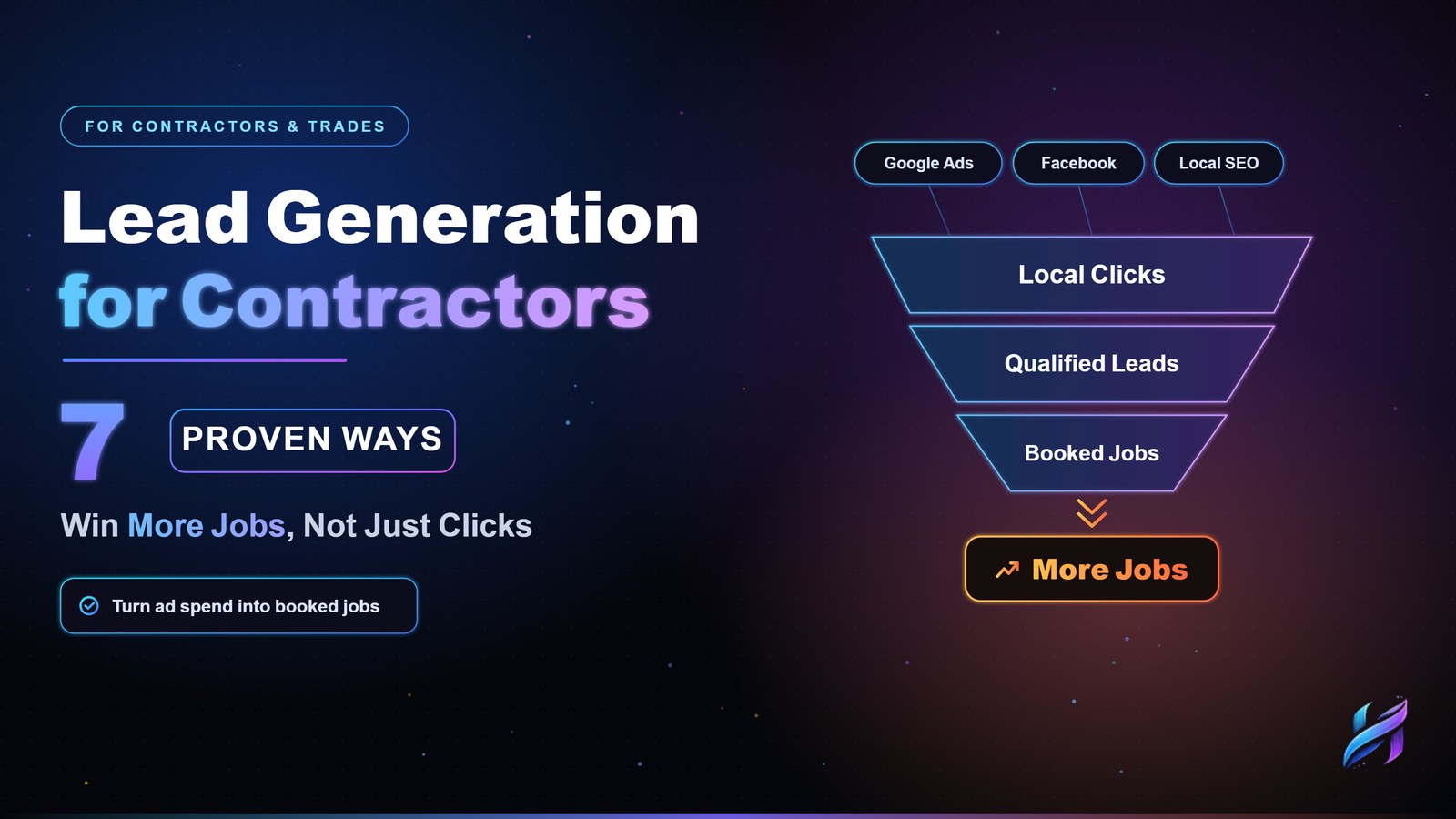
Lead generation for contractors is not about chasing clicks or growing a following. It is about one thing: getting more of the right people to call you for work you actually want.
If your phone is quiet, no amount of brand awareness fixes it. This guide breaks down 7 proven ways to build lead generation for contractors that books real jobs, the metrics that tell you it is working, and the mistakes that quietly drain a budget. Everything here applies whether you run HVAC, electrical, roofing, plumbing, or any other owner-operated trade. The goal is not more marketing for its own sake. It is a predictable flow of booked work you can count on month after month, without wondering where the next job comes from or which channel is actually carrying its weight.
Table of Contents
- What lead generation for contractors actually means
- Why most contractor lead generation falls flat
- 7 proven lead generation strategies for contractors
- Lead generation by trade
- How to know your lead generation is working
- Mistakes that waste contractor ad budgets
- How long until lead generation produces jobs
- Frequently asked questions

What lead generation for contractors actually means
Lead generation for contractors is the process of turning strangers into booked jobs through a repeatable system, not luck or word of mouth alone. A lead is a real person with a real problem, who left you their name and number because they want the work done. Everything else, impressions, likes, page views, is noise until it produces that contact.
The trades have a specific advantage here. Demand is high-intent and local. Someone with no air conditioning in July or water on the floor at midnight is not browsing for fun. They are ready to pay. The job of a lead system is to be in front of that person at the exact moment they go looking, capture the contact, and get a human on the phone before a competitor does. Done right, a contractor lead system turns that urgency into a calendar full of jobs.
There are two halves to it. The first is the channel that creates the demand or catches it: paid search, paid social, your Google Business Profile, your website. The second is the follow-up engine that converts the lead into a booked appointment. Most contractors obsess over the first half and ignore the second. That is exactly backward, and it is why so many ad budgets underperform.
Why most contractor lead generation falls flat
The number one reason contractor marketing fails is speed, not spend. A lead that sits for an hour is a cold lead. Research on lead response from the Harvard Business Review found that companies who contacted a new online lead within five minutes were far more likely to reach and qualify that person than companies who waited even 30 minutes. People who fill out a form or click an ad are shopping right then, and they call the next contractor on the list while you are still on a ladder.
The second reason is poor targeting. Boosting a post to everyone within 40 miles burns money on people who will never buy. The third is sending paid traffic to a weak page. If your ad promises emergency electrical service and the click lands on a slow homepage with no phone number above the fold, you paid for a visitor and threw them away. Strong lead generation for contractors closes all three gaps: it reaches the right person, sends them somewhere built to convert, and follows up in minutes.
There is also a measurement problem. A lot of contractors cannot tell you their cost per lead or which channel produced last month’s jobs. If you do not measure it, you cannot improve it, and you end up renewing whatever the last salesperson sold you instead of doubling down on what actually fills the schedule.
7 proven lead generation strategies for contractors
No single channel wins on its own. The contractors who stay booked run a few of these together so a slow month in one place is covered by another. Here are the seven that consistently produce.
1. Google Ads on high-intent searches
When someone types “AC repair near me” or “emergency electrician,” they are ready to book. Search ads put you at the top of that result the moment the need exists. The key is bidding on problem-and-solution keywords, not vague terms, and pointing every ad at a focused landing page with a click-to-call button. This is the fastest way to turn on demand, and it is why we build dedicated Google Ads management around the searches that actually convert.
2. Google Local Services Ads
Local Services Ads sit above the regular search ads and charge you per lead, not per click. They carry a Google Guaranteed badge and show your reviews right in the ad. For licensed trades, this is some of the highest-intent inventory on the internet. Google verifies your license and insurance first, then feeds you calls and messages from your service area. See Google’s own Local Services Ads overview for how the screening works.
3. Meta Ads to fill the slow weeks
Search captures people already looking. Facebook and Instagram ads create demand before the emergency, which keeps your pipeline full in slower seasons. A tune-up offer, a financing message, or a simple before-and-after of real work can generate leads cheaply when search volume dips. The trade-off between the two channels is worth understanding, which we cover in our breakdown of Google Ads vs Meta Ads for local businesses. Most booked contractors run both, and we manage the social side through Meta Ads management.
4. Speed-to-lead follow-up with a CRM
This is the highest-leverage fix on the list. The moment a lead comes in, an automated text and email should go out, and a call task should hit your phone. A CRM that texts a new lead within 60 seconds will out-book a competitor who calls back after lunch every single time. Automating that first touch is the core of our AI CRM and marketing automation, and it is usually where a stalled lead program turns profitable.

5. Database reactivation
You are sitting on leads you already paid for: past customers and old quotes that never closed. A simple text campaign to that list, a seasonal tune-up reminder or a “we have an opening this week” message, books jobs for almost nothing. Reactivation is the cheapest source of contractor leads because the trust is already there. Most shops have hundreds of dormant contacts and never message them.
6. Google Business Profile and local SEO
Your Google Business Profile is the map pack that shows up for “near me” searches, and it is free. Keep the categories accurate, post photos of real jobs, and answer questions. Pair it with service pages on your site that target what you do, and you earn leads month after month without paying per click. Search ads turn on demand today, SEO compounds it over the next year.
7. Reviews as a conversion engine
Reviews are not a vanity metric, they decide who gets the call. Survey after survey, including BrightLocal’s annual Local Consumer Review Survey, shows that most people read reviews before hiring a local business and trust them nearly as much as a personal referral. A steady stream of recent five-star reviews lifts your map ranking and your Local Services Ads, and it raises the close rate on every other channel. Ask for a review by text the day the job is done, while the customer is happy.
Lead generation by trade
The channels above work for every trade, but the mix that pays shifts with the work you do and how customers find you. Here is where to put the emphasis.
HVAC
HVAC demand spikes with the weather, so search ads and Local Services Ads carry the summer and winter rush when people search “AC repair” or “no heat.” The opportunity is the shoulder seasons. Run Meta Ads for maintenance plans, tune-up offers, and financing in spring and fall so the schedule never goes flat. Speed-to-lead matters most here because a hot house in July is a same-hour decision. See our approach to HVAC marketing.
Electricians
Electrical splits between emergencies and planned upgrades like panels, EV chargers, and generators. Local Services Ads and Google Ads win the emergency and “electrician near me” searches, while Meta Ads sell the upgrade work that homeowners think about for weeks before they act. Reviews are decisive because people do not gamble on electrical. More on electrician marketing.
Roofers
Roofing is storm-driven and high-ticket, so the close takes longer and follow-up is everything. Capture the post-storm search surge, then use automated follow-up and retargeting to stay in front of homeowners while they get other quotes. A wall of recent reviews and real job photos closes the gap against the door-knockers. See roofing marketing.
Plumbers
Plumbing is the most emergency-driven trade on this list. A burst pipe or a backed-up line is a right-now problem, so whoever answers first books the job. Lean hard on Local Services Ads, search ads, and the fastest possible follow-up. Demand-generation ads matter less here than simply being impossible to miss the moment something fails. More on plumber marketing.
How to know your lead generation is working
Booked jobs are the only scoreboard that matters, but a few numbers tell you why the scoreboard reads the way it does. Track these every month and the picture gets clear fast.
- Cost per lead. What you spent divided by leads produced, per channel. This is how you compare Google Ads against Meta against Local Services Ads honestly.
- Booked-job rate. Of the leads that came in, how many turned into scheduled work. A high cost per lead with a high booking rate can still be your best channel.
- Speed to first contact. Minutes between a lead arriving and a human reaching them. Push this under five minutes and everything downstream improves.
- Cost per booked job. The number that actually pays your bills. Optimize for this, not for clicks or impressions.
If your provider cannot show you these, that is a problem. Good contractor lead generation is measured in jobs and dollars, not screenshots of reach. When the reporting ties spend to booked revenue, you finally know where to put the next dollar.
Mistakes that waste contractor ad budgets
Most wasted budget comes from a short list of avoidable errors. Fix these before you spend another dollar.
- Slow follow-up. Leads go cold in minutes. No automation means leaking money out the back of every campaign.
- Sending ads to the homepage. Paid traffic needs a focused landing page with one offer and a phone number up top, not a general site.
- Chasing reach and likes. Awareness feels good and books nothing. Tie every campaign to a lead and a call.
- No call tracking. If you cannot tell which ad produced which call, you are guessing. Track the phone, not just form fills.
- Pausing in the slow season. That is exactly when cheaper clicks and demand-generation ads keep the schedule from going dark.
None of these require a bigger budget. They require a system that respects the speed and intent of how people actually hire a contractor.
How long until lead generation produces jobs
Different channels pay off on different clocks, and knowing the timeline keeps you from killing a channel before it has a chance to work. Set expectations up front and you make calmer, better decisions with your budget.
Paid search and Local Services Ads are the fastest. Turn them on, and calls can come the same week because you are stepping in front of demand that already exists. The first two or three weeks are a learning period where you trim wasted search terms and tune the landing page, and cost per booked job usually drops as the data builds. Meta Ads take a little longer to find the right audience, often two to four weeks before the creative and targeting settle into a reliable cost per lead.
SEO and your Google Business Profile are the long game. Reviews, fresh service pages, and accurate categories compound over three to six months into a stream of leads you are not paying per click for. The smartest play is to run paid and organic together: paid fills the calendar now while SEO lowers your blended cost per job over the next year. Database reactivation sits in the middle and is the quickest win of all, since a single text to past customers can book work the same day. Treated as a system rather than a one-off campaign, these channels reinforce each other instead of competing for the same dollar.
Ready to turn on a steady stream of jobs?
HelixEdge builds lead generation for contractors that ties every dollar to booked work, with the ads, the landing pages, and the automated follow-up handled for you. Stop paying for awareness and start filling the calendar. Book a free strategy call and we will map the fastest path to more jobs for your trade.
Frequently Asked Questions
What is the best lead generation for contractors?
The best lead generation for contractors combines Google Ads or Local Services Ads to catch high-intent searches with fast, automated follow-up that contacts the lead within minutes. Search ads bring people who are ready to book now, and speed-to-lead follow-up makes sure you reach them before a competitor does. For demand in slower seasons, add Meta Ads. See how the paid channels compare in our guide to Google Ads vs Meta Ads.
How much should a contractor spend on lead generation?
Spend should be set by your cost per booked job and your capacity, not a flat number. Start with a budget you can track to revenue, measure cost per lead and booked-job rate by channel, then scale the channels that pay. The goal is a predictable return, where every dollar in produces more in booked work than it costs. Our Google Ads management is built around that math.
How fast should I follow up with a new lead?
Within five minutes, ideally within one. New leads are shopping the moment they reach out, and contact rates drop sharply with every minute that passes. An automated text and email the instant a lead arrives, backed by a call task, is the single highest-return change most contractors can make. We automate that first touch through AI CRM and marketing automation.
Do Facebook ads work for contractors?
Yes, when they are used to create demand rather than catch it. Facebook and Instagram ads put a tune-up offer, financing, or real before-and-after work in front of homeowners before the emergency happens, which keeps the pipeline full in slow weeks. They pair best with search ads and fast follow-up. We run the social side through Meta Ads management.