
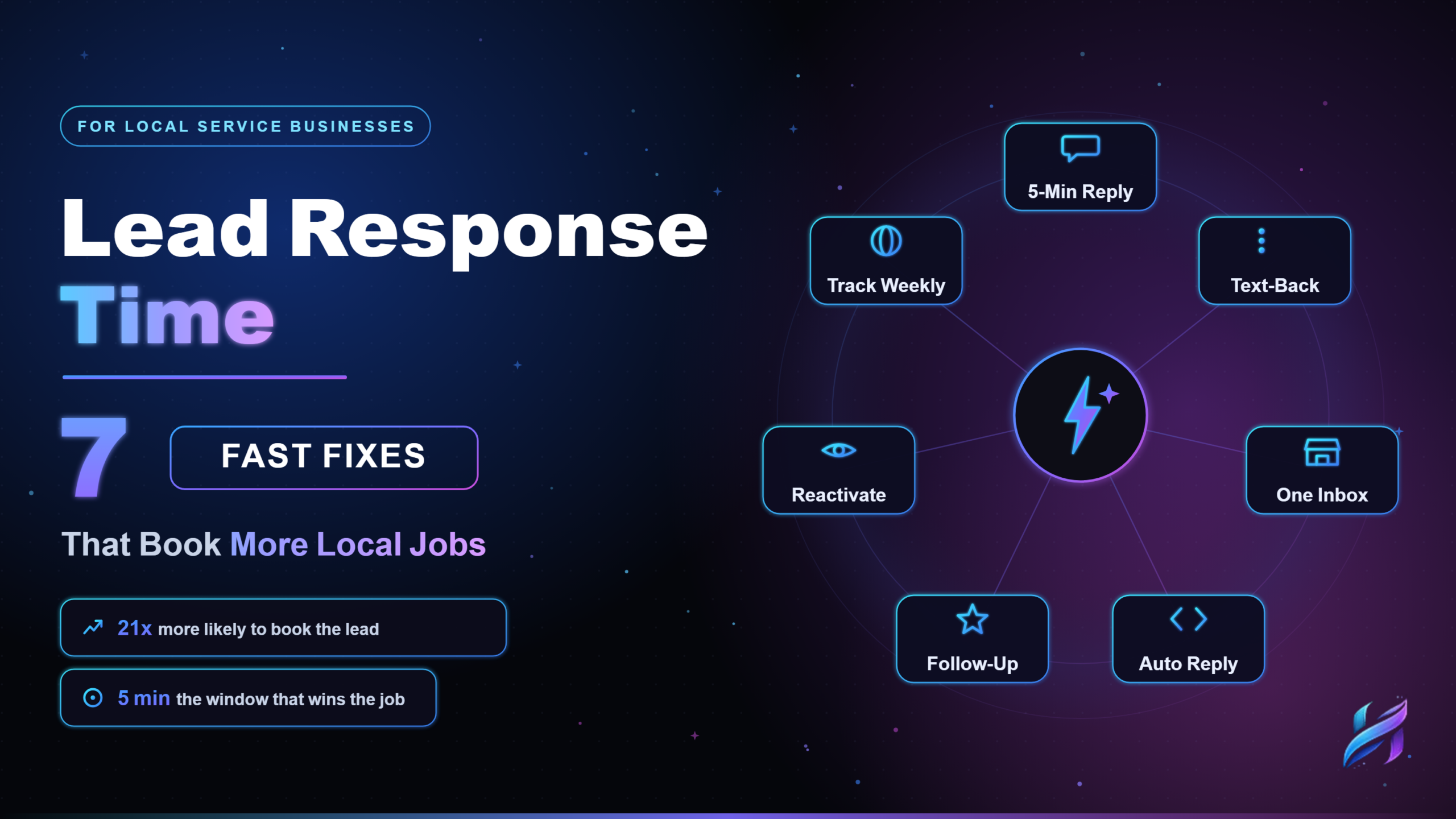
A homeowner calls your shop or fills out your form, then they wait. If your lead response time is measured in hours instead of minutes, that job is usually already gone. The customer did not sit by the phone. They pulled up the next three companies on the search results and one of them picked up before your voicemail finished playing.
This is the quiet leak in most local service businesses. You spend real money to make the phone ring, then a slow reply hands the work to whoever answered first. The good news is that speed is one of the few things you fully control, and it costs almost nothing to fix. Below are 7 practical fixes to tighten your lead response time and turn more of the leads you already pay for into booked, paid jobs.
Table Of Contents
- Why Lead Response Time Decides Who Wins The Job
- Fix 1: Answer Every New Lead Within Five Minutes
- Fix 2: Turn Missed Calls Into Instant Text Replies
- Fix 3: Route Every Lead Into One Inbox You Actually Watch
- Fix 4: Automate The First Reply, Keep A Human Right Behind It
- Fix 5: Follow Up More Than Once, Because Most Owners Quit Too Early
- Fix 6: Reactivate The Old Leads You Already Stopped Chasing
- Fix 7: Measure Your Lead Response Time Every Single Week
- What Faster Lead Response Time Does To Your Bottom Line
- Frequently Asked Questions
Why Lead Response Time Decides Who Wins The Job
Speed is not a nice-to-have. It is the difference between a booked job and a wasted ad click. A well-known study run with MIT and InsideSales.com, built on more than 15,000 leads and over 100,000 call attempts, found that replying within five minutes instead of thirty made a lead 21 times more likely to enter the sales process. Not 21 percent more. Twenty-one times.
Harvard Business Review reported the same pattern from a different angle: most companies respond far too slowly, and the ones that reach a new lead inside the first hour are the ones that actually get a real conversation. The window is short because buying intent is highest the moment someone reaches out. A person who just watched their water heater flood the garage is ready to book right now. An hour later they have already hired someone else and moved on.
For an owner-operated shop, this is good news. You cannot always outspend a national franchise, but you can out-respond them. A fast, human reply beats a big brand that makes people wait. Every one of the leads you work to generate is only worth what your follow-up turns it into, and lead response time is the first lever that decides that outcome.

Fix 1: Answer Every New Lead Within Five Minutes
Five minutes is the target, and it is not arbitrary. It is the point where contact rates and booking rates are still near their peak. After that they fall off a cliff. So the first fix is simple to say and hard to do: treat every new lead like a small fire that needs to be put out in the next five minutes.
The reason this is hard is that you are on a roof, under a sink, or driving between calls when the lead comes in. That is exactly why the answer is not “try harder to be by the phone.” The answer is a system that fires the first response for you while you finish the job in front of you. Willpower does not scale. A process does. The rest of these fixes are the pieces of that process.
Start by defining what a five-minute reply even looks like for your shop. It does not have to be a full quote. It can be a text that says you got the request, you handle that exact problem, and you will call in the next few minutes to lock in a time. That single message tells the customer they picked a real business, and it buys you the time to reply properly. The goal is to be first, then be thorough.
Fix 2: Turn Missed Calls Into Instant Text Replies
Most local service leads still come by phone, and most of those calls come while you are already working. A missed call is not a small thing. Studies of home service buyers show the majority will not leave a voicemail and will simply call the next company. So the missed call is a lost job unless something catches it fast.
The fix is a missed-call text-back. The second a call goes unanswered, an automatic text goes out: “Sorry we missed you, this is Mike at the shop, what can we help with?” Now the lead is a text thread instead of a dead voicemail, and you can answer it between jobs without breaking your day. Shops that turn this on often recover a real share of calls they used to lose outright, which is money they were already paying to generate.
This is one of the highest-return moves you can make, and it runs through a simple AI CRM and marketing automation setup. The system watches for the missed call, sends the text in seconds, and keeps the whole conversation in one place so nothing slips. Your response time on missed calls drops from never to a few seconds, without you touching your phone.
Fix 3: Route Every Lead Into One Inbox You Actually Watch
Here is a pattern we see constantly. A form goes to one email. Facebook leads sit inside Facebook. Google calls hit a cell phone. The website chat lands somewhere nobody checks. Each channel is a separate island, and leads drown in the gaps between them. You are not slow because you do not care. You are slow because the lead is somewhere you are not looking.
The fix is one inbox. Every lead, from every source, lands in a single place with a notification you cannot miss. Phone, form, Facebook, Google, website chat, all of it in one thread per customer. When there is one place to look, a fast reply becomes possible. When there are six places, a fast reply is luck.
This also fixes the handoff problem. If you have even one person helping in the office, a shared inbox means they can catch a lead the second you cannot. No more “I thought you called them.” The lead is claimed, answered, and logged, and your response time stops depending on which device happened to buzz.
Fix 4: Automate The First Reply, Keep A Human Right Behind It
Automation gets a bad name because people picture a clunky bot that annoys customers. Done right, it does the opposite. The job of the automated first reply is to buy you time and set expectations, not to close the sale. It answers in seconds so the customer knows they are in the queue, then a real person takes over.
A good first reply confirms three things fast: you received the request, you do this exact work, and here is when a human will follow up. That is it. It should sound like your shop, not a call center. The moment that message lands, the customer stops shopping around because they feel handled, and you have bought yourself the runway to reply properly between jobs.
The key word is behind. Automation is the front line, not the whole army. A person still calls, still quotes, still books. The system just makes sure the clock never beats you to the punch. A tuned marketing automation flow can text, email, and even schedule the callback while you keep your hands on the actual work. That is how a two-person shop answers like a ten-person one.

Fix 5: Follow Up More Than Once, Because Most Owners Quit Too Early
Speed wins the first contact. Persistence wins the rest. A large share of leads never reply to the first attempt, and most owners give up after one call and one voicemail. That is where the money is left on the table. The lead is not always dead. They are on a roof of their own, in a meeting, or feeding a toddler.
Build a simple follow-up sequence and let it run. A practical rhythm looks like this: text and call within five minutes, a second touch a few hours later, one the next morning, then a couple more spaced across the next week. Mix the channels. A text often gets a reply when a call goes to voicemail, and the other way around. Five to seven touches over a week or two is normal and it is not pushy, it is professional.
The point of automating this is that you will not do it by hand. You mean to, then a busy week swallows the reminder. A sequence that keeps nudging until the lead replies or opts out protects you from your own schedule. It keeps your response time consistent on touch two through seven, not just on the first hello.
Fix 6: Reactivate The Old Leads You Already Stopped Chasing
You are sitting on an asset you forgot you own: the list of everyone who ever called, quoted, or booked and then went quiet. Old estimates that never closed. Customers from two seasons ago. Leads you replied to slowly and lost. That list already trusts you enough to have reached out once, which makes it the cheapest work you can win.
A database reactivation campaign is a short, honest message to that list. Not spam. A quick check-in tied to a real reason: a seasonal tune-up, a maintenance reminder, an opening in the schedule this month. Because these people already know you, response rates beat cold outreach and the cost is close to zero since you are not buying new clicks. You are reheating leads you already paid for.
The reason this belongs in a piece about lead response time is that reactivation is the long tail of the same idea. Some leads you were slow on the first time are still reachable. A steady, automated campaign gives those slow-response leads a second, faster chance, and every job it recovers is pure upside on money you already spent.
Fix 7: Measure Your Lead Response Time Every Single Week
You cannot fix what you never look at. Most owners have a gut feeling that they answer fast, and that feeling is almost always wrong. The only way to know is to measure your lead response time on real leads, every week, and stare at the number until it improves.
Track three things. First, average time to first response, by channel. Second, how many leads got a reply inside five minutes versus how many waited an hour or more. Third, your booking rate against those response times, so you can see the money the delay is costing. When you put a booking rate next to a response time, the argument for speed stops being an opinion and becomes math.
Pick one number to improve each month. Maybe it is getting missed-call text-backs to under a minute. Maybe it is making sure no weekend lead waits past Monday. Small, measured gains stack up fast, and because you are watching a real metric instead of a hunch, you can prove the change worked. Speed you can see is speed you can keep.
What Faster Lead Response Time Does To Your Bottom Line
Tie it all together and the picture is simple. Every job you win from a faster reply is revenue you were already paying to chase. You did not spend a dollar more on ads or SEO. You just stopped handing warm leads to the competitor who answered first. That is why lead response time is one of the highest-return fixes in a local service business: the cost is a bit of setup, and the payoff is jobs you were otherwise losing.
It also compounds. A shop known for answering fast gets better reviews, because the experience starts strong before anyone even sends a truck. Those reviews pull in more leads, and a tight response process turns more of them into jobs. Speed feeds itself. Whether you run an HVAC company, a plumbing crew, or an electrical shop, the same loop holds: reply first, book more, earn the review, repeat.
None of this requires a bigger team or a bigger budget. It requires a system that catches every lead, answers in seconds, follows up until it gets an answer, and shows you the numbers. Put that in place and you stop competing on who spends the most. You start winning on who cares enough to answer first.
Ready To Stop Losing Leads To Slow Replies?
If your leads are slipping through the cracks between voicemail, email, and Facebook, the fix is a system, not more hustle. HelixEdge builds the automation that answers in seconds, follows up on autopilot, and puts every lead in one place, so you book the jobs you already pay to generate. Get in touch and we will map out where your leads are leaking and how to plug it.
Frequently Asked Questions
What is a good lead response time for a local service business?
Aim to make first contact within five minutes, because that is where booking rates stay near their peak before dropping off sharply. For most owner-operated shops the realistic way to hit that on every lead is automation: an instant text or email fires the moment a lead comes in, then a person follows up. A simple AI CRM and marketing automation setup handles the instant part so you are never depending on being near your phone.
Why do I lose leads even though my Facebook ads get plenty of them?
Usually the leads are fine and the follow-up is the problem. Facebook leads often sit inside the platform where nobody checks, so by the time you reply the person has hired someone else. The fix is to route every ad lead into one inbox with an instant reply and a follow-up sequence. If you want that built into your campaigns, our Meta Ads management connects the ads straight to fast follow-up so the leads you pay for actually get answered.
Does response time matter for Google Ads leads too?
Yes, and arguably more, because Google Ads leads are often high-intent people ready to book right now. If you make them wait, that intent goes to whoever calls back first. Fast response protects the money you put into search, which is why our Google Ads management pairs the campaign with a follow-up system so clicks turn into booked jobs instead of missed calls.
Is it worth improving my website and SEO if I answer leads slowly?
Fix the response process first, because more traffic only means more leads you can lose slowly. Once you answer fast, better rankings and a stronger site pour more qualified leads into a machine that actually converts them. That is when search engine optimization pays off the most, since every extra visitor meets a business that replies before the competition does.